
Tags
draft riots, ghost, ghost photography, Ghosts, halloween, horror, paranormal
First published on January 29, 2013
The original description: “During the closing years of 19th century a modest journalist of supernatural phenomena moves from California to the edges of young metropolis to collect evidence of serious disturbances in Ennistown Hotel. Checking in to a room from which everyone else is checking out in the middle of the night, may be asking for evidence that is not equally benevolent compared to his previous cases.”
“NEW YORK PD RECORDS 72 Mercer St. Station Wed 18th May 1892
QUESTIONER: Sgt. Keniston McKilley
RESPONDENT: Mr. Orville Joynter (by business card)
OCCUPATION: (Confirmed by spouse Tue 17th May) Editor and owner of magazine Eerie Occurrences 92 East 17th St. (also home address)
Cause of confinement: The death of Mr. Jeremiah Marchand, janitor of Ennistown Hotel, 13 East 13th St. under suspicious circumstances. According the records, Mr. Marchand’s body being without any external injuries when found but the cause of death is still unknown: Mr. Joynter remains under arrest.
NOTES: 3RD ATTEMPT FOR HEARING. MR JOYNTER WAS IN A STATE OF SHOCK AND VIOLENT BEHAVIOR WHEN CONFINED AND HAS BEEN LOCKED AT PRECINCT SINCE. THIS HEARING AUTHORIZED BY DR. JACOB KEVINSON M.D: PATIENT BEHAVES REASONABLY AND IS CAPABLE OF SPEAKING BUT RADICAL MEASURES ARE NOT RECOMMENDED UPON INTERROGATION. THE PATIENT SHOULD REMAIN CUFFED.”
*
A week earlier, Wednesday 11th of May 1892, the previous editor of West Coast press and current metropolitan ghost hunter, Mr. Orville Joynter left Mrs. Jezebel Levinson’s lodge for fresh occurrences in downtown. His business in Mrs. Levinson’s lodge had been the possible materialization of Mr. Levinson, deceased decades earlier in Civil War. He regretted deeply for Mrs. Levinson that during a week’s investigations, his observations did not include any unearthly action in the premises and in his admirable way urged her to just keep the loving memory, which undoubtedly may have the initial reason for the late soldier’s appearance into the eternally mourning widow’s eyes. This was not helped by keeping the Union officer’s parade uniform in the bedroom wall.
Mr. Orville Joynter was a married, good-mannered professional of information; a flat man with middle height and age, wearing gray coat and dark trousers and pointed beard as brown as his hair, which was protected by a bowler. His wife was somewhat religious, not participating into husband’s activity but open-minded enough to accept the occasional long absences and helping in publishing the Eerie Occurrences magazine. The society enjoyed Mr. Joynter’s stories, keeping his income steady; but nightly outdoor watch occasionally drew patrolling police officers, camouflaging Mr. Joynter into a nature enthusiast for nocturnal animals, even with a species pocketbook.
Mr. Joynter did not consider himself an over-enthusiast hypocrite who would publish every fog movement, rushing owl or temperature creak; nor did he raise any faith for contact to the deceased. He was plain curious and his tools were the notebook and a camera, into which a skilled watchmaker had devised a delicate and exact shutter mechanism for long nocturnal shots, which he processed himself with a laboratory which tailed him in a trunk during travelling.
Mr. Joynter had faith on ‘good olde ghosts’ like his former West Coast journalist colleagues had expressed. Indeed, California was too’ fresh’ for Mr. Orville Joynter to catch anything but ‘opium-induced phantoms’. The place to feast upon strange noises and figures in the darkness was ‘the ancient East Coast’; countless tragedies leaving restless souls to hover and clatter with their unfinished business. Mr. Joynter politely refused from invitations to spiritist seances and had little faith on Ouija boards; he adjusted the ghost frontier into juxtaposition with wildlife, the game would not appear by calling; the word ‘game’ being safe in daylight but in darkness Mr. Joynter was more obedient to self-preservation.
*
Mr. Joynter’s procedure was a routine: First a discreet meeting with people who had invited him, in this case the owners and manager of Ennistown Hotel at East 13th Street. Subtle approach included reporting in only when there were no customers present; Mr. Joynter was just another fresh resident. Having signed the extraordinary contract and receiving all possible material, including the history of the building, Mr. Joynter proceeded to local press archives to find details of all possible incidents that may have caused the current disturbances. The results were satisfactory: Mr. Joynter passed a minor fire, though two persons had perished due smoke. Instead he nailed his interest into local infamous Draft Riots during the Civil War. Ennistown Hotel had been raided by rioters and for unknown reason the residents of a certain hallway in second storey did not withdraw into safety of their rooms but were wondering about the intruders at their doors, where they were slaughtered by gunfire and knives. Possible reason for this was due journalist profession of these guests, creating fake sense of safety and neutral position in front of the crazed horde.
Mr. Joynter proceeded to have coffee in a canteen nearly opposite the hotel and surveyed its looks: Ennistown Hotel was a typical local public structure, built in 1837. It lacked the splendor of grand hotels but was ideal for those in journalist profession who wanted to stay invisible and neutral in their reporting duty. Flat brick façade with fire escapes forming peculiar shadows and simple two-column doorway would make it a modern style four-story inn.
After these observations Mr. Joynter switched to interview notes concerning the disturbances. The hotel director had collected some of these incidents into his journal, the pages now in Mr. Joynter’s temporary possession. The accounts had one consistent feature: All witnesses had reported the air turning extremely cold at about 11 p.m. in rooms of a certain hallway, not very same night except one incident describing residents of two different rooms descending hastily to reception with all their belongings and in a shocked state. Their account proved similar to others; the freezing air and then in half-darkness with only streetlights and weak room light, the corridor door was observed being suddenly a little open but no corridor lamps’ night lighting was entering. Instead a shadow of a half figure, like someone entering halfway from behind the door but just standing there in a narrow space between the door and opening, creating an inexplicable atmosphere of terror. The phenomenon ceased instantly upon setting lights full, door was closed as before and no sound heard. Of course common sense would put this into account of night lighting and shadows creating tricks in any over-perceptive eyes, if not whiskey-tired travelers. But the first observation was always of that freezing air, waking up those who had dozed off or getting attention of those still awake. Hotel personnel had afterwards reported moist covering some places, like there had been ice melting inside rooms. First occurrences commencing during the winter, the natural consequence had been to reprimand the lodger about keeping window open to freezing night. No exceeding moisture or wallpaper decaying, a testament for failing plumbing or roof leaks had been observed. But the phenomenon was slowly causing moisture damages. The Ennistown Hotel was not ready to close rooms for repairs before investigations were done, so instead Mr. Orville Joynter would have the exclusive privilege for the whole corridor for a week’s time. For Mr. Joynter this presence of moisture was an excellent piece of evidence, usually unearthly occurrences left nothing but the suspicion against witnesses’ accounts if not very unclear photographs by overzealous camera artists.
However, Mr. Orville Joynter always made it clear that he was not a ghost fighter or an exorcist; he merely collected evidence and published it. Like with many other public places, he woved to keep the exact premises anonymous unless asked for public attraction. Currently, Ennistown Hotel was hardly a case for public attraction since the fleeing customers and their refunding.
Mr. Joynter noticed a sidenote in the last page, written vertically to left side of body text: ‘Ambrose Corrin, Herald photographer at site’. Producing a natural effect of curiosity, Mr. Joynter deciced to postpone his settling into premises and took a cab to the Herald. He wrote up near a whole dollar from his accounting before he was talking to a friendly editor in the Herald office. The latter did not hesitate to show his eagerness to help with the archives, producing ghastly photographs taken by Mr. Corrin in the morning following the massacre in Ennistown Hotel. They were not different from the gruesome takes from the Civil War, but also fell to the very category of memento mori so intriguing at the current times. Mr. Joynter observed the bodies lying on the pools of blood, on the corridor floor or inside room where hapless victim had managed to withdraw but not avoiding the bloody madness; most of victims lying in the door opening and eyes left wide open, unless the face had been smashed in. Though Mr. Joynter was not a newcomer with photographs of the deceased, the wide staring eyes without signs of life produced him shivers deep in spine. Also the last plate representing the whole horrible setup from the end of the corridor somehow added to anxiety, this counting per fact that he was going to spend nocturnal time in the very same premises. Adding to restless thinking, the helpful journalist also explained that despite of being a battle-hardened photographer, Mr. Corrin was never again the same person after visiting Ennistown Hotel that morning. Upon inquiry about copies Mr. Joynter accepted with pleasure. Of course this meant if there were ghosts, the copies would surely be welcomed into Mr. Joynter’s archive, not to mention identifying any ghost. He was happy enough to mark the fateful rooms and doors into his notes.
While returning in the cab along the cobblestoned streets, Mr. Orville Joynter cursed his suddenly appeared anxiety. This case was somehow different; there were no two words about it. Was it the atrocious nature of the incident? Not only; Mr. Joynter had realized there was something deeper while he watched the photographs. A warning from deeper consciousness? In the jumpy cab, Mr. Orville Joynter rested his head and gladly let the warm and light deceive him.
*
The bellboy had arranged luggage into the room Mr. Joynter had chosen according the photographs. A square space, the hallway door at the right corner; red wallpaper with somewhat too strong patterns; and armchair and two tables for coffee and work. The bed seemed adequate and felt actually more comfortable. Apart from wallpapers, the impression was very Spartan.
In this room, a Philadelphian journalist had his face left intact in otherwise very deceased body, a slump between the door opening according Mr. Corrin’s ghastly photographs. If he was about to hover on his spot of ultimate violence, Mr. Joynter could have the best of chances to identify him. This, of course, if the honored apparition would be better than blackish figure or just white mist. Moreover there was the behavioral aspect: This time the audience would not be ignorant and innocent bystanders to be terrified.
All this Mr. Joynter wrote into his journal during the evening. He was offered to have the dinner served into his lodging but he politely refused and informed the manager to contain the visit to dinner room into his research, scrutinizing the atmosphere as broadly as possible. Mr. Joynter was tactful enough not to look like too curious among the other visitors but wrote down the observations only after returning from dinner, which he found satisfying without any ill air around. So the fateful corridor may be the sole spot of alleged supernatural phenomena.
During the evening he received his trunk of archives, different tools and liquids and converted the closet into a laboratory for photographic work.
Between 9 p.m. and 10 p.m. he set up the camera on its sturdy pedestal in front of window, pointing to the door but containing the widest possible view to the room. Then he pulled a long, rigid cord from the camera through a small pulley over the door, a gadget hotel management had accepted to attach into wall. The rest of the cord he then attached into a nail near top edge of the door. Now the opening door would trigger the camera shutter, which would then close itself by the ingenious system of the watchmaker.
He doused all lamps except the reading light. At this stage he heard knocking from the door; requesting the identity he disabled the camera arrangement and met the janitor, Jeremiah Marchand, for the first time. This human giant of five feet and four inches at least and shoulders like barn’s door had volunteered to provide the coffee pan straight from the hotel kitchen, as the rest of service were either home or not willing to visit the passage at this hours. Mr. Marchand grumbled back at Mr. Joynter’s gratitude but said also that he ‘had little faith on anything else but some delinquents breaking in and causing the mess.’ He had no faith at all on such profession Mr. Joynter represented, not a surprise when taking a note on his own practical profession of keeping the building in running state and also some guarding due recent occurrences. He offered his company in case of pranksters but Mr. Joynter politely asked him to keep some berth elsewhere per research requirements, and the fact that janitor clearly had an impatient nature. Mr. Marchand submitted to this according his superior’s intructions but remaining available if things went wrong. Janitor’s office was located in the basement but he would patrol the other passages frequently during the night, being allowed to sleep daytime between his duties as long as these disturbances existed.
Finally, Mr. Joynter asked the janitor to close all possible windows and ventilation and the access doors to the hallway: Mr. Joynter had his load of useless photographs presenting invisible disturbances induced by natural currents of air.
Mr. Joynter set up the camera cord again and settled into the mahogany, thickly padded armchair, cursing its comfort; an inconvenient seat for anyone who had decided to stay awake in darkness. He poured the coffee on the small table next to him and sipped it gratefully. Then he glimpsed his pocket watch. He had some time so he took the notebook and started preparing his article for Eerie Occurrences, relating this case into noticeable amount of other Civil War based occurrences.
Just before 11 p.m. he put his notes aside, stood up, stretched his limbs and walked to the window. Gas lamps faintly illuminated the now scarce traffic clattering along the pavements. He carefully opened the window just a little, to test the level of external noises and was satisfied to note that unless something extraordinary occurred out there, he could isolate the possible sounds from any noises in his room. The faint voices and stepping in rooms above had ceased for the night, at least he hoped so. Being satisfied so far, he sat back into armchair and tried to keep the scientific layer on top of others in his head. As a human being, he still had some restless thoughts pushing through the layer of clinical attitude. He checked the time and doused the reading lamp, letting only the faint city lights to form shadows everywhere.
*
He snapped awake and almost put the reading light on, gave up and tried to peek the time from his watch: 11.20 p.m. Nothing seemed to have occurred. Still something had woken him up. He noticed that he was trembling. He got awake a little more and suddenly knew he was nearly in panicking terror. He usually smoked very little but now he opened the drawer under coffee table and took his cigarettes, lighting one with great difficulty. The inhaled smoke made him cough but other substances caused some relaxation. He stubbed the cigarette and blew out the remaining smoke.
The smoke changed color to white but did not cease.
Mr. Joynter realized he was blowing steam into suddenly frozen air. He closed his eyes and tried to breath smoothly. Opening his eyes again, he squinted first at the figure of the camera set-up, then the faint door in far left corner. It was still closed. Or was it? Had the camera been triggered? It was colder than during regular winter. He saw the slight frost in the window and noticed he was trembling more, and only partly due cold. Mr. Joynter was in terror.
He slowly stood up, taking a few steps towards the door, still trembling. It was open, something in the darkness confirmed it. Then he noticed the black something between it and the opening, halfway into the room. He stood still for a moment trying to isolate the loud blood circulation and thumping heart. Seconds later he heard somebody talking a sentence backwards with echoing voice, only one sentence. Then it said ‘No!’ and screamed. The mercy of darkness entered his head but before he fell onto the floor unconscious, he heard the sound of camera shutter closing.
*
The face of janitor hung above him. The lights were on. His head was raised a bit and some water poured down his throat, which caused some coughing but also cleared his thoughts. Mr. Joynter rose into a sitting position and shook his head. To the inquiry of frightened janitor he just commented being in shape and he must have slipped. Mr. Marchand in turn shook head and grumbled his attitude towards the ‘gnome hunting’. He helped Mr. Joynter into the armchair, where the confusion faded and our ghost hunter suddenly found himself staring at the camera arrangement. After a moment he checked the time and with all politeness asked janitor to leave. Mr. Marchand first refused but he saw Mr. Joynter’s resolution and withdrew for the search of nocturnal intruders, declaring that they might have been behind the state of Mr. Joynter, who almost succeeded in smiling at the wide back of the janitor.
It was midnight. Mr. Joynter continued to stare the camera with heavy contemplation. The watchmaker had done remarkable design. A design that might have captured something more unearthly than ever.
Mr. Joynter’s archives from his career contained no less than over 40 plates taken of different, supposedly supernatural forms. Only 12 of them were taken into dry plates, the first 28 were on wet plates and hardly valid evidence due worse sensitivity for lesser light. The new type, roll film was not qualified enough for people like Mr. Orville Joynter, the captor of darkness; but dry plates were something of a treasure for more or less scientific photography for dark environments.
And that was frightening.
Still not one of the 12 dry plates could provide anything but possible movement of ‘something’ in the dark premises, hardly worth printing. What Mr. Joynter had witnessed by his own eyes, were burned in enough to have a place in his sketchbook and sometimes in Eerie Occurrences.
He sighed and having a faith in possible apparition’s sense of schedule, withdrew into bed. Next day would show the result. Before that, Mr. Orville Joynter managed to have pure, tranquil sleep of only two hours.
*
Mr. Joynter marched out of the closet, carrying a print developed from dry plate, stopped, glimpsed the print, lowered it and continued marching around the room, cursing in a way his wife would have declared him at servitude of Beelzebub. Between the cursing anyone near could have heard him muttering about ‘something that definitely was there’.
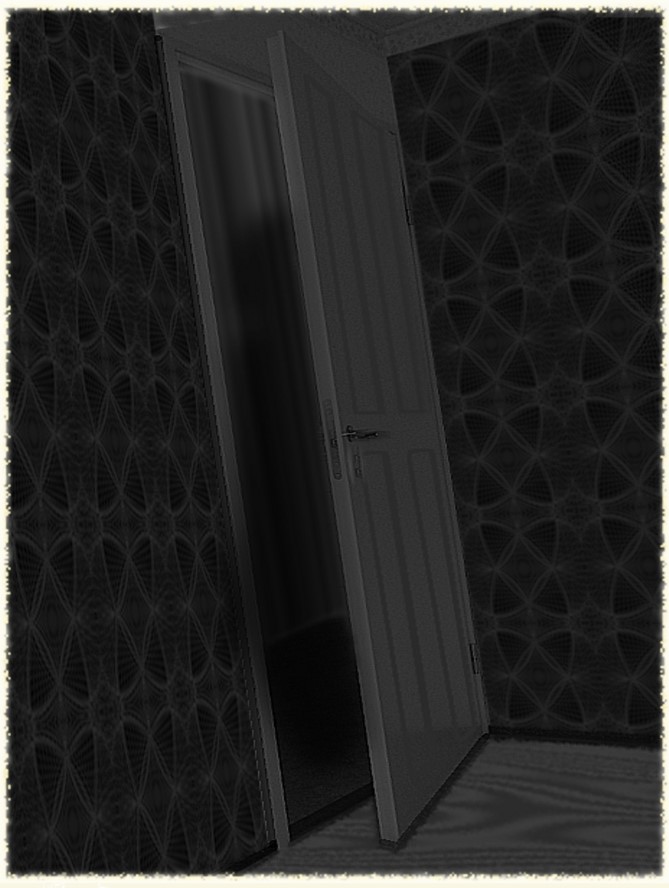
The print possessed a gorgeously sharp image of the door, half open in the dark. Multitude of different shadows occupied wallpapers, caused by external lights and internal objects like thin curtains. At the left side there was a strange figure lining down, the bending knees isolated clearly but otherwise the long exposure had captured the fainting Mr. Joynter himself, a testament for the fact that something had occurred.
Then, how was the door half open and empty, the carpet patterns and lamp on the opposite wall clearly visible? But nothing at the door. The cord from pulley was visible in upper half and coming out of the focus near the camera. The question about camera lens not being covered by frost which had affected the window, was merely secondary and thus far he set it into account of more protected position.
Being hungry he noticed the time was almost late for lunch, packed the dried print into portfolio and marched downstairs. Settling for the meal he chewed and planned the action for oncoming evening.
He needed to discuss with the hotel manager.
Mr. Joynter swallowed the rest of coffee and appeared modestly into reception, requesting to see his employer. This was at his office and Mr. Joynter was welcomed. The hotel manager was short, average half-dressed and well fed. As a matter of fact, he was just having his post-lunch coffee as Mr. Joynter entered. The ghost hunter reported his account politely with a style of any official reporting statistics: The incident with voices, door, fainting and recovery by Mr. Marchand, which had actually been already reported by janitor himself. Finally he told about the setback with the photograph and pulled the print from portfolio. The hotel manager was sipping his coffee and took the print with other hand, careful not to finger it too much.
Mr. Joynter was explaining his own falling figure in the print, when the hotel manager went pale and his eyes widened, he spit out the coffee and fell backwards with his chair. Mr. Joynter was quick to save the print from spilling coffee and stared at the hotel manager, who stared back and seemingly in terror asked what was behind this sick trickery. Mr. Joynter started explaining again that there was nothing but his own strange figure, but when he glimpsed the print himself he dropped back into seat as pale and wide-eyed as the manager. Actually he let out a very audible grunt and put the print aside, staring back at the manager who was climbing back to his chair.
Mr. Joynter apologized again and again without having courage to look at the print again too soon. He tucked it back into the portfolio. Then an awkward silence fell for a moment, until the worst had vanished from the hotel manager’s face. He declared to Mr. Joynter that ‘any continued investigation of these incidents should have the janitor’s presence backing up the safety’. Such trickery, if not supernatural, would be quickly disposed of if Mr. Marchand got his fingers around the trickster’s throat.
Mr. Joynter knew better but did not say a word, the suddenly changed print in his mind. He agreed and an arrangement was made for Mr. Marchand to accompany Mr. Joynter before 11 p.m. next night. Mr. Joynter then returned to his room in the passage of terror.
He sat into armchair and pulled the print out very carefully and slowly. Not a drop of coffee had spoiled the image, which now had a new figure. Mr. Joynter felt tickling at his head and he knew his hair was somewhat raising along his heavy breathing. Cold sweat started to glisten in the forehead and he wiped it dry, not to spoil the testament of unnatural in front of him. Now there was a man in the opening, in the position of entering the room. No transparency could be seen. Eyes where clear, white, wide and definitely malevolent. The spot of mouth and lower part of nose were horribly twisted, compliments of long exposure for moving chin, so the figure had screamed. It seemed his throat had been slit open. There was no indication of visible steam from breathing. The apparition’s clothing was decades old and the vest had large stain running down the chest. It could have been anybody pulling a prank for another resident; but what raised the terror was the familiarity of the horrible face and clothing, despite the exposure effects Mr. Joynter could identify the figure as a certain Philadelphian journalist, slain during the Draft Riots at the door of this very room decades ago, a figure equalling to the corpse that was printed into Herald’s archives by Mr. Ambrose Corrin.
For once, Mr. Orville Joynter had found exactly what he came for, and he regretted it.
*
He would not back off. His design always included full research and observations, regardless of initial success. Now he fought the terror inside but something in his spine kept him going: Running away would mean throwing away years of work and the whole meaning of his selected life. He did not know if his health would be in physical danger, mental side being definitely in perils.
Mr. Joynter visited Herald’s archive once again and asked for solitude during research. The comparison performed could have been too much for anybody else. While leaving, the helpful editor righteously asked if Mr. Joynter was all right. The shaken and pale ghost hunter replied with accusation towards a fever and expressed his gratitude, then returning to Ennistown Hotel for planning further investigation.
The janitor’s attitude was somewhat difficult. Only Mr. Joynter had witnessed the changing of the photograph but showing an image of a bloody man at the door would not teach Mr. Marchand any respect for the dangerous circumstances. He had to trust the diligent working man’s sense of reality.
Mr. Joynter lessened the pressure on his nerves by managing to take a neutral attitude and examining the print with magnifying glass. So far he did not find any other explanations than the unearthly figure carrying such spectrum that developing liquids did their work very slowly; or worse for his profession, somebody doing a prank while he was unconscious. Janitor? Definitely not.
The master image in dry plate did not initially reveal the figure. And so it was that upon re-checking the plate, the ghastly figure had appeared there. Mr. Joynter must remind himself that he was possibly working with forces beyond the laws of physics.
He recovered the closet laboratory for further processing of new takes and used better part of the evening writing his article for Eerie Occurrences. He also wrote a letter for his wife, copying part of his account there. He left the most frightening details off not to make his wife worry too much. The letter he delivered to reception for further voyage, proceeded to use some time with the dinner, and ordered the coffee pot for next night. Then he returned upstairs with a fresh newspaper and took his thoughts off supernatural for couple of hours.
Mr. Marchand entered Mr. Joynter’s room with fresh coffee pot 10.42 p.m. waking up Mr. Joynter. He had dozed off with the newspaper. Upon janitor’s mocking about waking up Mr. Joynter again, the latter answered only by pouring coffee for both. Mr. Joynter took one sip and asked if janitor should visit outside the room before early hours. The janitor replied he was ready for night’s watch and his host proceeded to attach the camera to the the door, feeling some anxiety while doing this. He decided not to show the print to the janitor. Instead he requested to know why this had brought along a baton and a hand gun, when they were laid on table. Mr. Marchand still grumbled about dangerous tricksters and handed the firearm to Mr. Joynter who submitted but did not give any thoughts for letting the gun go off. Mr. Marchand planned to work as the spearhead of capturing the tricksters with baton but agreed to let the camera collect the evidence first. Mr. Joynter did not even try to explain the nature of circumstances, the janitor was too stubborn. Both took their positions, janitor sitting at the coffee table and Mr. Joynter in the armchair. The latter did not hide being content about Mr. Marchand’s presence. Despite the danger of stubborn janitor spoiling the opportunity, feeling more safe Mr. Joynter was certain of successful results.
At 11 p.m. the men left themselves sitting in the darkness and once again ghost hunter’s eyes got used into the shadows in the wallpapers and faint noises outside, though he must ask the janitor to curb his low grumbling about delinquent pranksters.
At 11.20 p.m. the hair of both men raised and the terror stole its way into Mr. Joynter who hoped the janitor had stronger mental health. Indeed, the large man was merely looking around like a sniffing animal. Soon after this the breath started to steam. Janitor let out a grumble about extraordinary tricks. Mr. Joynter got his attention by hushing him silent with lifted finger. Then both freezed to watch the door. Though breathing heavily and hardly noticing the freezing air, Mr. Joynter managed to gesture the overactive janitor to stay at his place for he hed heard the slight sound of camera opening the shutter.
There was nothing between the door. Mr. Joynter could see the night lighting of the hallway. Then they started hear the voices. Many different voices, which perhaps were spelled backwards. They grew louder and suddenly the passage was filled with yelling crowd, the thumping sound of numerous feet approaching their door. The weak passage lights seemed to go out and a mass of darkness appeared to the door. In horror, Mr. Joynter saw this act differing from his previous nightmare. Mr. Marchand now jumped up towards the door yelling ‘to get you pranksters’ and raised the baton over his head. As soon as the janitor reached the door, Mr. Joynter saw something sword-like running through his stomach, and again through the chest so that it was shortly visible from janitor’s back. Mr. Marchand roared with pain and stood still for a moment with confused face. Then he fell to the floor and trembling Mr. Joynter could swear he saw a pool of blood spreading to floor in the darkness.
The camera shutter closed audibly and the dark mass was gone. The door was closed and janitor’s slumped figure inside. There was a momentary silence, then a hallway door far away slammed open and confused ghost hunter heard more feet thumping and shouting clear words. He took the revolver and shot through the door, the second shot hit the pedestal of the camera which fell with clamor but the cord got safely loose without exposing the plate again; he shot through the wall, through the ceiling and finally through the window. He heard the shouting from the passage begging to stop shooting but then he went over the edge of reason and started screaming.
After a moment’s silence a policeman who ran in from patrolling the street and couple of residents broke in to meet the cold body of Mr. Jeremiah Marchand and living Mr. Joynter who could not stop screaming. He tried to lift the gun towards his head but the swift policeman twisted it from his hand. More hands became available due the noise, and finally more policemen who helped the crazed Mr. Joynter out and to the precinct. For poor Mr. Marchand there was nothing to be done, though the bystanders wondered his otherwise intact body. No blood or damage was observed and his face presented one’s that had gotten into heart attack, the face twisted in pain and terror.
*
Early in the morning, the police inspector and a photographer appeared to the door. The camera professional was a certain Mr. Ambrose Corrin Jr., who offered his services to police and aftermaths of violent incidences like his father had done. As the police examined the room and hallway, several plates and one roll film were filled with the scene. Mr. Corrin then found the fallen camera set-up of Mr. Joynter’s very interesting; the police naturally accepted him taking it away for processing the images it might contain from the strange scene of the tragedy. He also got the photographic archives of Mr. Joynter’s luggage for further investigation.
The hotel manager explained the police that Mr. Orville Joynter was an adventuring journalist interested to capture the moments janitor might catch a burglar, the cause of the nocturnal harm in the hotel.
Police records of later reveal that Mr. Orville Joynter was found not guilty of slaying Mr. Marchand but rather a failure of heart was the reason of the janitor passing away. Mr. Joynter was passed to an asylum for an undefined time and his other belongings to Mrs. Joynter, who faithfully continued to publish the Eerie Occurrences, containing a strange account from a hotel in New York.
Police records do not reveal that after the investigation was over, Mr. Ambrose Corrin Jr. retired from police services and moved far away, never to touch a camera again.
Officially the case involved no other photographs than those taken by the request of the police.
* * *
 Mika's Chatter Channel