
(This small literary piece is pure fiction and for the benefit of traditional gothic horror friends, following the original style of the era. Some expressions may look odd to the casual reader but author could not be happier if that leads into some research. Baroque style music is strongly recommended to accompany and perfect the reading experience. This story is available free in e-book formats in https://www.smashwords.com/books/view/221816 )
~~~~~
During the summer of 1790, it occurred in most convenient of times to vicar Godwinson of Dainsdale–a thin man of five feet and eight, age four-and-sixty with an inadvertent semblance to a raven with his nose and clothing by office–that his parish would be merited by a new proprietor to Scyllaclough Grange; which was under perils of dereliction due former landlord’s corrupt ways of life and his passing away as a result. For the vicar, the divine intervention was a matter of conjecture. Wealth and peerage of the corrupt baron did little to accomplish anything amidst the dilapidating structures of Grange, its lush forests and moors and least among his peasants; instead he was under inclination to favor his peers and nobles with higher rank in such ways that they completely overlooked his misconduct of duties within his possessions.
Under these circumstances it was highly digestible that we could find our vicar measuring the landscape, which surrounded the manor mouldering with exuberant growth; and in particular the Jacobean main building itself where recesses between broken bay windows were gradually covered by ivies. Half a score years separated this sepulchral scene from the time vicar Godwinson refused to enter the property; in fear of testifying heathenish rites along the gardens; compared to which the barbaric picts and superstitious druids would seem Fellows of Royal Society; such was the deliberate degradation of position and possession that vicar required an oath from his congregation not to enter Grange property unless exclusively ordered to do so; and in this latter case, minding just their own business. The vicar shuddered upon recollection of involuntary visitations in Grange; but raising his eyes to the bright sun he turned joyous in expectation of new landlord, about whom he had been in exchange of letters with the bishop of the country: According to the bishop the new squire–a certain Mr Tollerson–was a gentleman of celestial sciences and deep knowledge; this creating in vicar some anxiety towards newcomer’s piety upon his subjects. Vicar’s anxiousness upon the matter was so well formed that bishop proclaimed a full page of praise about Mr Tollerson’s dignity; good reasoning was also due bishop’s knowledge about the figure of previous master at Scyllaclough Grange, as he had been in sacrifice of his own time to write letters of consolation to keep the distressed vicar of Dainsdale in strength and faith. To vicar Godwinson’s joy, Mr Tollerson had been much involved within education; this being a natural part of his profession. Vicar Godwinson gave stout credence to the piousness of these mundane prophets; his own being acquired by a rector who was delighted by Newton’s proficiency to piousness and explanations of ‘physicks’.
~~~~
Vicar Godwinson’s current spot was picked with excellence as he was standing on the east-west passage of trees, the main coach route overlooking the low-situated manor; behind which small hills were rolling around a high one which almost hid the forest lines far behind. This particular hill had its own name but vicar Godwinson refrained from spelling it; for it was the most wicked spot of baron’s degraded plays with his guests. Without pressing these thoughts further, vicar heard a rumble growing in the distance, then hoofs and wheels were separated and from a road turn galloped a convoy of coaches and smaller carts. Vicar stepped aside removing his hat; and so the new dwellers of Scyllaclough Grange passed him: In the second coach sat the servants, third was loaded with trunks of value, fourth and fifth were carts with more coarse commodities and small furniture. There were two passengers in the first coach: First a noble shadow clearly pressing a cane against coach floor, before the face with concave nose and strong chin giving a conception of great determination and dignity. Next to him was a bit more difficult figure to distinguish but vicar had time enough to note elder feminine features. The convoy advanced past vicar, raising a notable cloud of dust until it turned right and rumbled down the alley flanked by rows of ancient and gigantic trees towards the Grange. Anyone who happened to see the sanguine expression in our vicar’s features at that moment, could not go amiss by saying that a face with such content had not been observed between those shoulders during a score of years. Such cheery were the grand expectations towards Mr Tollerson, a scholar and new squire of Scyllaclough Grange.
~~~~
To vicar’s great pleasure he witnessed the restoration works at Grange to begin immediately and during his everyday rambles along the road he could hear the commotion of tools and workers. Then, after a fortnight a messenger appeared to gates at vicarage and, after being confirmed about vicar Godwinson’s person, he delivered an invitation to a dinner at Scyllaclough Grange. The messenger himself was tall and thin with bony facial features, wearing an intriguing mixture of gamekeeper and servant dress; his tone was low but expressions were clear and well-mannered. The vicar could not resist inviting the guest inside but the messenger insisted on returning to his master, ‘as the duties continue as ever.’ Vicar promptly set the messenger free and returned to his study for further inspection of the letter. It appeared to be a formal invitation to a dinner, indicating also that neither great festivities nor grand parties were to be expected. This was a delight for the vicar for he preferred the pulpit in front of his congregation rather than a seat in great party of higher peerage; not to mention the former landlord’s corrupted style. At the agreed evening he turned from the main road to alley leading to Grange, sitting in a carriage driven by sexton McNally; and was thinking exactly his last visit to the doors of Grange. If vicar was shivering, sexton could not tell for he was joining to recollections of the ill times of previous squire. But the grand hill behind the manor remained empty, no ungodly figures dancing around it in accordion with some inhuman drumming, as it had occurred less than a score years ago. Instead the sun was retreating behind the hill, coloring the low clouds with dark gold and yellow, after a moment they would be blood-red. These were the thoughts of vicar and sexton of Dainsdale as they brought the team to halt in the shadow of the manor; front doors were promptly opened by a servant and vicar stood down from the carriage, leaving strict instructions to sexton about collecting him in a certain time not afar. Meantime would be spent in an inn by the sexton, this was not unclear to vicar Godwinson but he would spare sexton McNally of any reproach; even vicar himself would not approach the Grange in the dark without some additional substance bringing courage. McNally then rumbled around the yard fountain and up away, to appear alighted in last rays of the evening sun on the main road; the servant of manor stood next to front door, but the vicar decided to have a look upon the building before more darkness. It warmed him to see latticed windows intact and some of them alighted from inside as it got late for the sun, now low behind the manor. Some vines were left between the window bays but less wild style. Cracks on wall were filled and painted over. East wing was still in need of the same exterior work but Mr Tollerson had not been in waste of time recovering Scyllaclough Grange to it’s original grandeur, to times before ill-fated baron. Ascending the steps vicar noticed the servant the very same person who brought the invitation. He was guided to the hall which was well lit, but far from clear for it was partly filled with wooden containers and chests, part of which were open; great amount of books and some most strange apparatus were to behold. Vicar Godwinson hesitated a moment but decided these belonging to the collection of a scholar. Getting disposed of his cloak, hat and cane, vicar was then escorted through doors to west wing where he met the couple in possession of the Grange; in a spacious long dinner room with decorated walls and a ceiling with a huge painting; which to great surprise to the vicar was of biblical origin. While performing this admiring action eyes up, vicar Godwinson almost stumbled upon a chair but having a decent situational awareness, the servant grabbed him. The middle-aged woman at the other end of the table held back a giggle while his husband stood up and approached:
“Well-met, Robinson! And well-met to you, vicar; and welcome to the new Scyllaclough Grange!”
“Pardon me,” vicar fumbled a bit with his footing but continued, “and thank you, sir. And allow me to express my gratitude of the invitation and welcome on behalf of the parish of Dainsdale.”
“Indeed, you are too kind. I am James Tollerson, a scholar they call me. Fear me not, I carry neither noble peerage nor a whip; at least not yet, if you allow such words. Let me introduce my wife and whip during research days and observing nights, Anna Tollerson.”
The vicar bowed promptly, the frolic woman stood up and with gentle steps seemed to glide across the floor. Vicar reached for woman’s hand but Anna Tollerson had already taken his hand with a firm grasp; which was unheard-of and vicar was well confused before Mr Tollerson intervened and with admonishing voice progressed the situation:
“Anna, Anna! I am certain the Father is well-educated and mannered; we should not deviate from the same path before well-acquainted.”
“Well, he is on our mercy now,” Anna almost giggled but added: “Forgive me, Father. I usually wish the formalities over as soon as possible.”
The vicar rallied himself and nodded with somehow constrained smile.
“Let us sit down,” Mr Tollerson declared cheerily, “Robinson, would you do the honors? Ah, Father, I forgot Robinson; meet the most staunch and reliable work-horse applied to any scholar.”
The tall servant nodded courteously and then proceeded to pour the wine and serve the dinner. Mrs Tollerson inquired local matters of interest from vicar, who did the best to reply and same time attempted to make his own suspicions to vanish. There was perhaps a slight discrepancy between vicar’s expectations and experiences thus far. Should a scholar be strictly made of same wood as vicar’s old teacher, the pious and Newtonian rector? The vicar took a quick glimpse upon Anna Tollerson’s hands; their skin was thick and there were few callus on them. Hard work was done with those hands and now vicar became conscious of the fact that despite perfect dressing of a lady, Anna Tollerson hardly used cosmetics, having affinity to those industrious wives and mothers in village and even with late Mrs Godwinson, who had perished under disease having hardly crossed her fifties. Whatever Mr Tollerson’s practices were, his wife seemed to stand by him. These thoughts were then interrupted by the squire:
“Father, we have some written formalities in our common path; mainly about the village and inhabitants; funding and taxes and of course the parish church. I understand my predecessor had rather, shall I say, ominous relationship to Dainsdale? Actually you don’t have to answer, he was too well-known up to the colleges and The Court; but capable to raise a storm, should any finger point at him. I shall not give any further thought to him, now.”
Vicar Godwinson depressed his face:
“I agree. There are things about this place I would rather bury and leave.”
“I’m certain of that. We already have found some curiosities, particularly from the vaults below and such machinery may only have been originated from applications of Spanish Inquisition. The only thing allowed to remain after baron is the painting up here. An exact copy of Creation, perhaps my predecessor had his own translation about it.”
“Oh. It is remarkable work and I am certain that the changes here will also denounce any evil burden from it.”
“Another thing, Father; can you tell anything about those hills, specifically the tallest one? I have my own revelations from my studies but perhaps you can tell something from your knowledge upon the matter?”
Vicar hesitated a moment but picked his words carefully:
“Sir, I would rather refrain from any account about former squire’s acts there but according my knowledge it is an ancient place of rites. I was told that the squire back then had some excavations made and some corners of large marked stones were revealed but there was no more after it; except sudden appearance of baron’s own rites. Oh, I’d rather forget them but the villagers have been and still are very careful with the place.”
Mr Tollerson made a quiet pose of contemplation.
“Yes, I believe you. These places always maintain superstition around. What comes to baron, I think he got his ideas from that hill. But let me be fair and honest with my forthcoming arrangements: Do you think any of your flock would do some building work there?”
Vicar Godwinson flinched but contained himself upon this unexpected inquiry:
“I would of course do my best to persuade but I’m afraid it would be in vain. But,” vicar said narrowing his eyes, “should you attend to my services, your presence would certainly lessen the suspicions among your subjects.”
“Ha! Anna, hark to the well-played response! Fear not, Father. You shall not have liturgies without us there. Think of this and meantime perhaps my Robinson and your sexton will run some errands and messages between Grange and rectory; our literal discussion and numbers about running this parish?”
Vicar felt a touch of sympathy but–and not least under the memory of the baron–kept his spiritual curtain walls only half-open.
“I am grateful under your friendly intentions. I shall promptly attempt to persuade my poor sheep according your inquiry.”
“I believe you shall do none the less. Thank you, Father. I cannot help to notice your modest appetite; I must warn you, I will run you around this place next time for I truly wish you to testify my implementations here.” Vicar Godwinson felt those words a bit unnerving but he was much more composed about the Grange when he climbed to sexton’s carriage in half dark yard. He turned to look back at manor and admired its new lighted tranquility amidst darkness, without malevolent commotion and racket of its former inhabitants and guests.
~~~~
Vicar Godwinson was content to observe the newcomers appearing in his church during next service. Mr and Mrs Tollerson sat smiling and with dignity on the rear pews, with stout Robinson behind them. They were the last to arrive; an arrangement that warranted the peaceful admittance of congregation to the church without being affright by squire of the Grange, though the previous one was never accused of putting his foot inside the church. Some villagers peeked nervously at rear pews but vicar had a gift of talking with such smoothness that even the most superstitious lot considered the church and service a true sanctuary. After putting aside his Book of Common Prayer, vicar Godwinson straightened himself in the pulpit and started the news and ended them with a proclamation of the new squire, declaring that men and women of work were needed at the Grange. Vicar was not surprised to see some parishioners trying to hide their heads between the pews; and promptly made a promise of his own presence during the works. The need was for wood-workers, smiths, stone-builders; maids and children were also mentioned, for serving the meals and running errands. Contract included also a paragraph to let workers to crops during harvest. Exiting the church, parishioners could sign in with Robinson, who had old sexton McNally next to him to encourage uncertain ones. There was, however, too great dispute over the new squire’s intentions, especially amongst the elder and those who were children during the detestable times of previous landlord. Thus only the count of one smith and two wood-workers was reached. Undaunted, Mr Tollerson told vicar that the works in the manor itself were still at large and there was no hurry with his schemes; the architect was yet to arrive from London and only after that would materials be imported to Grange. At vicar’s inquiry about current workers at manor, Mr Tollerson only responded them being far from their homes and contracts expiring; moreover, their renovating skills were not needed. Having declared this, Mr Tollerson invited vicar to another visit to the Grange “during any worthy and bright dusk.”
~~~~
Aforementioned sunsets and bright nights were not rare in that particular part of England; which, according the new squire, “was the first and foremost motive to acquire the Grange for the benefit of scientific applications.” Thus observing such an evening settle behind the window of his study, vicar Godwinson put aside his papers and remnants of a most limited meal–he refrained upon grand dinners while at home and preferred to work at the same time–and sent for the sexton who promptly picked him up and drove to Scyllaclough Grange. There ever-stout Robinson led him through the hall which was now cleaned up and decorated by glorious landscape paintings and portraits of family. The servant opened double doors to the library which was undoubtedly the highest space in the manor, advancing from the hall through the east wing and taking the whole height of two storeys. It was merely a corridor between flanking bookcases and vicar observed the spiral staircase ascending to a balcony circling the space, and more shelves could be told from the dimness. The squire himself was sitting in the more spacious end of the library, holding the only properly lighted spot with several lamps; he was loading his long pipe at large oak desk, paved with papers drawn full of circles, lines and calculations. In the walls were more paintings and framed drawings but they seemed odd to vicar, representing circular bodies surrounded with light dots in darkness. Mr Tollerson stood up for reception; he was wearing a worn out, somewhat tattered coat; his wig was on table but there was no sign of any remorse for not keeping it.
“Robinson, you could have warned us before bringing in stray clergymen,” the squire said smiling and reached vicar with his hand, “Welcome, vicar. I take it, this honour comes from my invitation to pleasant weather?”
“Yes, though I’m a bit at loss about your demonstrations to God’s poor servant? I hope it is nothing from your late predecessor’s collections,” vicar Godwinson replied as he sat down by squire’s gesture.
“God help me, no. Yet it is no surprise to anyone that there are some regrettable resemblances within our practices; separated only by my purely scientific methods against his worshipping of superstitions with the aid of celestial bodies. Before we bury them, I must tell you that some of those shelves now hide some unholy wall paintings; in the ceiling there is a celestial map, exact by stars but very incorrect by constellations which represent the baron’s religion, whatever it was. In other words, this space used to be his ‘sanctuary’, if that word is allowed. But he was not quite unaware of celestial movements; he just seemed to pursue them with totally infidel ways. The village out there must be most fortuitous one if children were not inexplicably lost.”
Vicar Godwinson shivered but replied from his memories:
“I recollect the constable going around the county and questioning after some people who were not local but lost and their last whereabouts were recorded on these roads.”
Mr Tollerson looked gloomy for a moment but decided to open a bit of the Grange’s wretched past to the vicar:
“Yes, I’m afraid we found couple of them from the vaults; poor souls. Rest assured that how ever strange and odd my applications may look to you, they are instruments of scholars and science. That is one of the reasons I want you to see my practices; so you can tell anyone with poor recollections of my predecessor, that our ways are exactly opposite.”
Vicar took a courteous position.
“At your service, of course but in this matter the emphasis is more upon your self-promotion and manners; into which I personally do not have any prejudices,” vicar concluded resolutely but not quite honestly; yet there hid an urge to have faith.
“A fair attitude. But certainly you have seen all the papers I have sent your way, all that needed funding is now taken care of; not at least the repairs of mills and your old church?”
“True, and I am grateful. But I heard you visited the village; I must make a remark for not taking me with you for my congregation’s faith upon you is still at move.”
“Yes, we did,” squire smiled,” Anna put me in a confusing position there; she went playful with the children and also pulled Robinson there, leaving me sitting in my solitude in carriage. And at first a couple of these children were hastily called home but returned by sheer gaiety of the rest. By my Anna there was no hostile face, have faith. I think we are ready.”
“It is joy to hear. But…What is this readiness, are you talking about your designs about the hill?”
“Indeed I am. And I feel great joy to reveal you my plans to educate these children by practices within putting the design in effect. They shall be the most prolific youngsters of celestial sciences when we have finished.”
Mr Tollerson’s eyes gleamed upon his proclamation but vicar Godwinson went pale.
“But sir, what is this? First you told that we were fortunate not to lose any children due baron; now you declare you shall take some advantage of them?”
“No. I ask you to keep faith. Or, shall I admit there is some benefit to my part but I am merely talking about running errands upon devising and building,” squire took a reassuring position, “and Anna for her part has promised to explain the matters, the mechanisms to the children, if not to the very infant ones. If classes are needed, she will arrange it. It will form the children’s own Invisible College! This will be our ultimate contribution to the country that allows us to ascend within celestial sciences!”
Mr Tollerson’s zealous outburst did nothing to ease vicar Godwinson’s position. He started to mutter something but at the same moment Anna’s voice was heard from the hall end of the library:
“Ahoy! James, you there?”
“We are here, dear Anna! Please join us. How did it go with the clockwork?”
“My dear James,” Anna begun with exultant tone as she approached from dark corridor of shelves, “I am afraid you owe me a guinea; you shall need a new escape wheel.”
Vicar stood up but as Anna entered from shelf corridor into the light, the countenance of lady-of-the-house was unheard of: She wore tattered working clothes and apron with dark greasy stains and she had just taken her maid’s cap and used it to rub grease from her hands, from whence the sleeves were rolled up revealing uncommonly strong arms for a lady; this countenance was crowned with black stains on cheek. Vicar Godwinson made a slight courteous gesture, as if not being aware whom he was addressing. Anna let out a laugh and dropped a curtsey.
“Ah, Father. Pardon me but as my dear husband wastes his precious time with numerical poetry and trigonometry, someone has to attend the practical side; which will then be me and poor Robinson who almost broke his back with the pendulum,” Anna explained to confused clergyman and then to her husband, “teething is awfully worn and cut in so short a time.”
“Yes, yes. But the mold is intact and correct; we shall strengthen the alloy and let it set a bit longer,” squire replied with a slight frustration but continued, “but dear, once you have cleaned your hands and the door knobs, could you tell Robinson or maids to deliver port or tea to our bored guest?”
“Tea please,” vicar added hastily and had an inquiring expression on his face, which the squire translated quite correctly:
“We shall have a look upon celestial wonders soon enough; you can see modest examples by my hand on the walls. They are painted as seen through my telescope.”
Vicar took a new look to some of the paintings as Anna exited and closed the doors in the far end.
“They are very odd to my eye, but well painted. I dare ask if the more earthly landscapes in the hall are your work?”
“Indeed, I got another present of nature–of God–at birth and while I was struck by our universe, I decided not only to make rough drafts like other scholars but to capture the whole glory. What you are seeing is the Roman god Jupiter with smaller bodies that circle him and other bodies more far away. The left is the painting of another body named by Roman god, Saturn. My architect described it a ‘ball in a bowl’. A few minor bodies around Saturn, too and my far advanced competitor Herschel says he has found more.”
“Herschel? I have read about him. He is in favor of His Majesty and also an able composer.”
Mr Tollerson looked a bit frustrated upon these notions.
“Yes, he has now the title ‘Royal’ with his practices; but I have something that, should the God allow, will drop the jaws at Royal Society with such a clamor that it resonates as far as in the Court. It has very much to do with my design, here.”
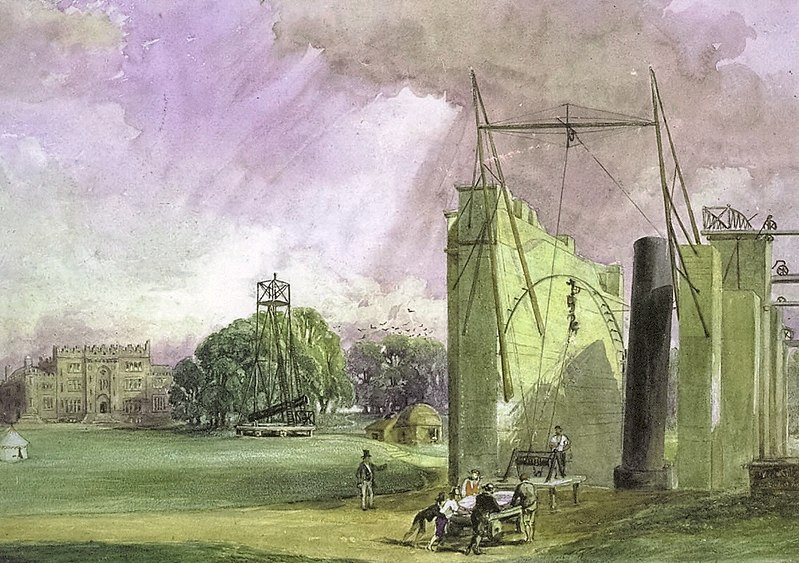
Having declared this, Mr Tollerson pulled a large sheet from under his calculations and drawings. It made vicar Godwinson to adjust his spectacles. The design was quite odd to him: It was an arrangement of two walls and a barrel as large, attached to some wheel machinery between them and pulleys above. Squire pulled another drawing, which had more artistic attitude; drawn by his excellent hand, the arrangement was clearly standing on the highest hill behind the manor. For some reason vicar felt sudden cold.
“This is the design you are inquiring the assistance of my poor herd with?”
“Yes.”
“Then I must note that should you show them drawing of a garden building or chapel or something else that average manor carries in its surroundings, they would not doubt for a second. But this…You must be aware of the level of superstitions around here; and you are asking them to build something that looks like–pardon me–an odd temple; in a spot where they will be reluctant to enter?”
“They do not need to see the result beforehand; only when it is nearly ready. By that time we have suppressed their superstitions. Nothing to worry, we will explain them that the place was worth even for our ancestors to observe celestial movements, nothing more. Neither cursed stones nor some unholy sepulchre. You, Father, are our best tool to explain your congregation that any cultivator of the lands needs to follow the heavens; true, is it not?”
Vicar had nothing to add but nodded; yet he knew that there would be lot of contemplating behind changing the local primitive philosophies into enlightenment. Squire knocked impatiently his fingers to desk couple of times and then noted with impatience:
“Well, no port or tea. I am afraid we have to begin without them. After you, Father,” he gestured towards hall doors far away. Vicar stood up and walked away from the lighted desk, into the half dark corridor of flanking bookshelves where gilded letters of Copernicus’ De Revolutionibus Orbius Coelestium, Flamsteed’s Atlas Coelestis, Newton’s Principia Mathematica and Cartesian philosophies glimmered; names Ptolemy and Hipparchus amidst some more odd Arabic names stood out from papers. Vicar then kept his eyes down and reached for recollection of some Evensong from his early days; and in the spiritual sanctuary he created, vicar Godwinson of Dainsdale listened his childhood choir singing with angels’ voice in his head.
~~~~
Although being a lesser scholar, vicar Godwinson’s experiences that night in Scyllaclough Grange left him with an impression of grandeur; such was the new squire’s mastery over his applications and lecturing. The impression was bolstered even further by the majestic sights offered by squire’s telescope, which vicar had presumed something of maritime style and size; hand-held glass or table application. Thus the barrel with six-inch aperture and length of seven-foot caught him off-guard, as did the Newtonian practice of looking into it from the side, not behind. The telescope was standing high on a balcony behind the house, upon a peculiar diagonal assembly, which squire explained to be the arrangement to ‘keep the universe halted in sight’; and which, as Anna had earlier declared, lacked the faulty escape wheel which resonated to the fact that squire had to explain the usage of guiding wheels, ‘in order to capture the celestial bodies in sight with their grandeur’. When intact, he explained, the clockwork would be ticking the telescope around without need of touching the wheels, once correctly adjusted and celestial body acquired into sight. This was the application which squire used to paint the celestial landscapes, having his both hands in disposal of the painting. To vicar’s inquiry about similarity to oncoming grand design on the hill, Mr Tollerson replied that its lateral movement was very limited, the field of vision and magnitudes sufficient in such a way that his work would be accomplished without further movement. After his goal would be achieved, the universal theories would change forever and with an invitation to Royal Society in his pocket, he would pursue even greater mechanisms. At this point vicar raised his eyebrow upon squire’s obvious ambitions but dismissed them as a standard for all scholars; after all, every God’s child was subject to most mundane rapacity, regardless of nobleness of the purpose. This was something vicar took a distant pride for his position being above such thinking. Yet there remained some nameless fear in vicar’s mind upon squire’s attitude. It hid itself during the gazing of the moon’s mountain ranges and their shadows; the red face of the God of War, Mars himself; and the great nebulae, celestial clouds in far greater distances “than our fluffy buckets of water in the sky,” per squire’s expression. Finally, when vicar expressed being exhausted by all the wonders, Mr Tollerson inquired him about “the obvious question, which he had faced more than once: Could these applications offer a sight to true Heavens; to perished loved ones, to angels, to God himself and the paradise?” Anna Tollerson seemed very touched as vicar’s answer was nothing aside his devotions: He explained with all his piousness that he “did not think those things were visible for poor mortals, not now and not with the strongest applications nor most wise beholders. The loved ones gone away should remain a beautiful memory; a faint feeling of something missing the rest of one’s life.” The rest of any biblical observations vicar did not wish to discuss, but begged pardon and with sexton’s carriage rumbled into the night.
~~~~
The works begun with constant commotion of carts running stones from distances and workmen built two thick walls, despite the season which demanded every and each man and woman to their crops as well. The children ran errands, messages and provisions between manor and hill and stopped sometimes to gather around Anna, who taught them about the movements of the sun and moon; and soon they were off again. Squire spent much of his time standing on site with shirt sleeves rolled up and comparing the attitude of the walls to his drawings. Hardly did the masonry dry enough when the smiths arrived with gears, pulleys, spars and struts and started to create a setup between the walls. When finished, they left behind two stone walls with intertwined support machinery between them and room for something large and adjustable. Thus, as the winter approached Dainsdale, this most peculiar setup was covered with great canvas and left alone to awake the curiosity of any passer-by. The Tollersons withdrew inside manor, where vicar Godwinson never met them idling during late autumn days; although Robinson informed vicar that at least squire slept long mornings after some nocturnal procedures and Anna was rather busy working with weights and pinions during daytime, and had great gaiety to teach village children who dropped in quietly through the scullery; which squire dismissed as if unaware. At last Tollersons agreed to spend some idle time after Christmas. The frame for the telescope was already ordered and would arrive with first leafs to the trees; the stage would be ready for the next chapter. Vicar Godwinson was moved when passing the manor as he saw two middle-aged shapes in the snowy yard, playing in and with the white cold substance like they were a couple in their twenties and younger; into which sexton McNally muttered something about the “squireless dignity with heads in the clouds.”
However, where the skills would not dissipate, goddess Fortuna had given her best; misfortune got its opportunity via a rather innocent looking omission and set up a tragedy behind the next corner.
~~~~
The winter time did not mean dismissal of the observatory, vice versa: The squire had initially built a foundry with two large furnaces to rear basement facing the great hill, in the space that was previously unused room right below the balcony. This arrangement was for casting the most precious of the instruments: The speculum, or the mirror. It would be the most finely adjusted work: The speculum mixture of copper and tin would be molten in the furnaces and then poured into the mold carefully devised by squire Tollerson himself. The village children had their part of joy in this process; under their slightly reluctant parent’s eyes they executed the process of pounding horse dung in mortars and sifting it through most fine sieves, to produce a mixture with loam, to be formed into a mold, an open womb for the speculum. Once in the mold, the speculum metal would cool down, ready for grinding polishing into a mirror.
During a cloudy mid-winter day, vicar Godwinson arrived amidst the heavy snow to Grange and the basement, which had already Anna and a few villager’s children and of course the squire himself, standing next to the mold between the furnaces and beholding the temperatures, sweaty in his shirt and sleeves rolled. He turned for a moment to wave his hand to vicar as a sign to keep still; then after a short minute, he gestured to a boy, whom vicar had not noticed and who was squatting in a shallow shelf inside the wall behind the furnaces, apparently to avoid the floor in case of leaks. The boy put his hand to a lever, and after another sign from the squire pushed it and molten speculum started to pour into the great mold. Squire held his palm in level, sometimes lifting or lowering it, marking the correct velocity of pouring the metal. The children, to whom the work of smith was not unknown but to whom this process was something more than just horseshoes, were standing as quiet as in church. This was marked by vicar Godwinson, just seconds before the disaster struck: The frame holding the pot gave up from the other side, the pot swung a bit and the squire stepped briskly forward but Robinson caught his sleeve and pulled him back; and while the squire glimpsed madly at Robinson, the frame gave up and the molten speculum metal poured onto the floor. There were short but loud shrieks from children, Anna was starting to soothe them and squire Tollerson had a face of contemplation until he started and bellowed for all to get out as the red thick substance settled onto the floor of flagstones. The boy jumped and ran from behind the furnaces. It was too late: The floor literally blew up with a horrible bang and clamor, both furnaces were split and part of the balcony overhead collapsed into the room, which any outside observer would have described as a shortly glowing inferno.
The vicar stood up from the snow and shook his head; he had flown outside through the doors by a large piece of stone hitting him into the chest. His heart was taking jumps and he was aching, still he felt fortunate for there was no pain from any broken ribs. He started to hear shrieking and sobbing from the ruins of furnace room. The vicar slowly got to his feet; but before he entered, the squire staggered out, mumbling strangely with bloody face, arms burned. Inside the ruined room he saw Anna sobbing and trying to move rubble in one corner and Robinson next to her, throwing the rubble away furiously; to his horror, vicar saw tiny, horrible burned arms moving about among rubble. Spilled speculum was mostly cooled but here and there vicar saw glowing spots and his shattered mind recollected Dante’s inscriptions. He kneeled next to the slabs of collapsed balcony floor, tried to move the weight but remained weeping, cursing his weakness. From under the pile extended crippled, lifeless feet of another child. On the spot near the wall stones were having a slight movement. Vicar entered the spot very carefully and moved the top stones with great effort; to his great relief he saw little girl’s crying face and comforted her until Robinson was freed by Anna as they revealed a badly burned small body in the other corner. Robinson then proceeded to carefully remove the heavy rubble holding the little girl; most amazingly she was physically intact apart from couple of wounds and dust; a slanting slab had formed a space around her, into which no other rubble had entered. By this time the scullery maids had arrived and after initial shock they nursed the two children alive. The speculum burned one did not survive one hour. The surviving girl was bandaged and taken to scullery and fed. Robinson followed a trail of steps and some blood on snow and found his master under a large, snowy tree, where squire was kneeled and mumbling, a gaping wound across his forehead and other in his foot. Later Robinson revealed to vicar that squire Tollerson had just kept repeating “How could I…So careless..? God, the floor stones…The cold, cold stones…God…Liberi…” and the rest perhaps some Latin.
Vicar Godwinson took a duty with sexton and returned the girl to her home; after which a task much worse remained: Knocking the village doors to deliver the sad news. One house took it with greater grief than another: Father and mother of six surviving children just sat down eyes glazed and said nothing, but at the blacksmith’s house there grew a great weeping by wife and a tremulous cry from husband; for after the firstborn, the wife was fertile no more and now their only light had vanished, smashed and burned by the stones and speculum of Scyllaclough Grange; upon which the smith vowed a horrible retribution. This got vicar Godwinson more worried, for the smith was very known not only by his great strength and size, but also from his gentleness which now was badly shaken and might release something most unexpected. At these pitch black prospects the village of Dainsdale and Scyllaclough Grange descended to an almost complete silence.
~~~~
The mourning village remained mostly silent as the waters were liberated from ice and guttered along the countryside revealing new stages of life. Vicar Godwinson had hoped in vain that the grim season would change along the increasing daylight and warm; but villagers went about their business in silence. It was only natural that no child was let even close to Scyllaclough Grange. But from the manor an increasing clamor could be heard. Vicar had made a few attempts to visit the manor but Robinson had turned him off, saying only that his master wishes to be left alone with his business. At every short-lived visit vicar had caught Anna Tollerson’s horrible weary face from the upper windows as he drove away. Vicar’s only source for the dying winter weeks was sexton McNally who seemed to have created something of a trust in Robinson, who discussed some manor matters along with a pint at the inn. The only thing McNally knew certainly was that squire had restored the foundry room and the design was going forward with help from elsewhere.
At last, when tiny leafs appeared to trees and bushes, Anna Tollerson appeared to gates of vicarage in a heavily loaded carriage. To vicar’s horror, his earlier observations were proven true. She had tried to make her face up, but no substance could hide twists and dark spots borne under the mental burden. Even her stance had descended. Vicar hurried for tea to her and urged her to lighten her shoulders. After a moment of silence during which she stared her feet, Anna begun her description and every word seemed to be accompanied with a tear: After initial disaster her husband had withdrawn into his study for two weeks and wanted to see only Robinson carrying provisions. Robinson had told her that squire had stolen to his wife’s chamber to see her condition after the disaster, but she was asleep after physician’s visit. She remained to impression that his husband was somehow ashamed, for he avoided any means of contact; but when she tried to steal into library to catch a glimpse of her husband, he had rejected the visit with such a cry that could not be repeated in vicarage. The design, however, was proceeding and it was true that the foundry had been restored. A total of four mirrors had been casted, ground and polished; from which two survived the inspection. Anna herself had no opportunity to partake these proceedings. She had repaired clock gears of the small telescope when she noticed that her husband had been delivered new pinions. She had observed him to use the newly repaired telescope, but with dark face and no new paintings appeared nor did he express any gratitude upon the matter. The frame of the great telescope would arrive soon with workmen and the observatory would be put the final touch. Having learned this vicar Godwinson now put the weight to Anna’s countenance: Was she leaving? The answer was positive; she had even tried to walk in the village in her grief but there was no response. A pair of ignoring eyes here and there, a little hatred glimpsed from windows but finally she realised the merciless solitude surrounding her. Currently Anna was travelling to her brother who had accepted her begging for lodging, at least for some time. Her last words in vicarage comprised of conjuring the vicar to intervene squire’s mental state before it was too late. According Anna, squire had now been under obsession for months and even Robinson was growing weary under such insane authority; which was very strong expression for vicar’s ears and he made a promise to get audience by any means. Having dried her eyes, Anna expressed her gratitude and left.
“What is it with this manor? Coincident and misfortune? A curse, God forbid?” vicar contemplated as he watched Anna Tollerson’s carriages disappearing behind trees.
~~~~
As soon as vicar Godwinson explained his sexton the urgency of matters, a shadow landed on McNally’s face as the state of poor Robinson was mentioned. As soon as they got on their way, vicar observed a keg stowed with them but made no inquiries about it. He knew McNally would come out with a design. Vicar Godwinson shivered as he disembarked before the carriage reached the manor yard, hiding himself among the flanking trees. Sexton drove to front doors and in a moment Robinson appeared but seemed to spread his hands in refusal to anything McNally was saying; but he looked more weary than mad; and when McNally pointed to the keg in the carriage, Robinson suddenly descended the steps and embarked the carriage, gesturing towards the stalls. Vicar Godwinson shivered as he realised the collusion performed to a person so familiar; but in no time he observed the front windows and stole through the doors, closing them behind him. He kept repeating himself Anna’s words that so far squire’s celestial obsession had not expressed violent nature, except the matter was not really tried in close range. All of a sudden a bell tolled, and after a long while tolled again. Vicar stood still in the dim hall.
“Robinson!”
The sudden and loud summons echoed through a large space; vicar started towards the library door and after knocking opened it and entered the high, dark corridor of bookcases.
“For Heaven’s sake, Robinson, come here, now! What’s the matter with you?”
“Sir, it’s me, the vicar, please!” Vicar Godwinson stuttered but kept his position. In the other end a figure started in the fluttering light of hearth.
“What? Who is there? Why, you..!”
Something was hurled towards vicar and Flamsteed’s work slammed onto floor in front of him, the distance being too long for such a throw. Vicar Godwinson now cleared his throat for the last effort:
“Vicar, Sir! It’s the vicar!”
A figure in the far stood still next to his desk, then sat down in resignation. Vicar approached with great caution. Squire Tollerson raised his face to meet him. If his wife’s countenance had caused pity, the squire’s face asked for dread. They were ghostly pale, which underlined his eyes, they were sunk and red, almost glowing and the dark spots under them had grown larger than his nocturnal profession had previously claimed. Vicar saw the squire had been on the verge of insanity for months now.
“Vicar. Please take a seat. Where is Robinson?” squire asked in submission.
“He is at the stalls having a chat with my sexton; it is not his fault. He needs some rest. And so do you, Sir.”
“What? First God decides to spill children’s blood to my hands and then He sends his solicitor to deceive my servants and me to halt our duties? I know you clergymen, in the end it is always you who stand in the way of knowledge. Why do you think I did not want to see you?”
Vicar Godwinson’s figure took a more rigorous position.
“I assure you, I have never been instructed from above or by any bishop to encumber any scholar’s work. I rather tell my flock that there are no witches around, which was quite difficult due your predecessor and now these sad incidents. I assure you; my faith was also put into test. For months my church has been visited only by people looking dead; what would I tell them?”
The squire looked at somewhere into much larger distance than the room, then walked into dim corridor and picked up the book, which had performed a short duty of weapon. Observing the state of the book he then presented it to vicar.
“Original Historia Coelestis Britannica. I can disclose the way I acquired it: My father saved it in time from the bonfire Flamsteed himself had put up at Royal Observatory to burn as many as possible. This was due discontent against some Newton’s actions with Flamsteed’s work: A magnificent example of our advancement, yet a sad result of dispute gone too far. No God is needed there, we scholars can make it complicated enough.”
Vicar sat with sulky expression on his face. After no response was given, squire continued:
“Next year you will see a quite different face between my shoulders; it will be the face of victory. And you will see poor Anna will be back with gaiety. And this spot will be known through England, if not everywhere; not for tragedies but for the greatest achievement in celestial sciences. It will halt the scholastic arguing and book-burning. And I will present it in front of Royal Society. Such a notion on celestial movement cannot be published without the echo through the whole world!”
Squire’s eyes were glowing deep in their sockets, and a more superstitious clergyman could have escaped; but vicar Godwinson could make the difference between possessed and madness-like obsession. The eyes lost the red glimmer and squire settled.
“Of course, if there was a God for me, I would return those children unscathed. Poor Anna, I could not let her close; not before I have fulfilled my assignment, my duty. She was more a disadvantage after the incident; she would take my mind elsewhere. Better for her to keep some berth now and let me perform it all.”
Now the vicar had his thoughts adjusted.
“I would that you, Sir, would give wide berth to all this for some time, for your and Anna’s sake. Please, gather new strength elsewhere. Then return to complete your work together, like you have done before.”
Squire turned his pale features to vicar and stared him under eyebrows.
“No. And now, vicar, I beg you to leave. You are not part of this, you are an obstacle, Sir. Good night.” Having said this, squire turned to desk and his attention to his surveys with seemingly stoic attitude. The vicar did not feel himself too safe to say anything, so he murmured his goodnights and left through the dim corridor of books, in which the gilded letters seemed to burn in reflection of distant hearth. Squire’s bent shadow danced in front of vicar up to the hall door.
~~~~
The following weeks saw the observatory completion. Much to his chagrin, vicar Godwinson testified a presence of hired guards occupying the previously empty gatehouse of Grange. Sexton had told that Robinson was still running errands to nearby town but would not have any business with vicarage. Robinson had yielded to the power of sextons beer keg but in the end the old loyalty towards his master had prevailed, although not before the sexton had questioned poor servant’s burden to a lesser scale.
The Grange observatory reminded vicar of great gun position. This particular late summer evening–between dusk and dark–he noticed lanterns navigating from manor to observatory, then squeaking noise as the squire’s figure was elevated in a lift to the great aperture of telescope. The observer thus did actually settle in front of large tube, not behind nor to the sides; vicar had understood that the speculum, the mirror was at angle which disallowed the observer’s head to block the incoming light; a slight geometric distortion of image represented no encumbrance. More squeaking was heard along some vertical and lateral movement of the telescope. The vicar could not tell whether there remained any hands on the ground, the telescope seemed to be adjustable by the observer. He turned for a few miles’ return walk to vicarage, but halted abruptly as he started to hear shouting from the direction of observatory. At first he took it merely the commands of squire but the wind started to carry quite a strange monologue as far as to the main road. Squire Tollerson, a scholar and man of celestial sciences, was shouting and cursing towards the void. It was nothing of usual, as there appeared more lanterns at the observatory, Robinson’s voice broke through begging his master to come inside; the gatehouse guards also stepped out, first confused but then making jokes of “poor cloud painter.” Aware and sad of the fact that the squire of Scyllaclough Grange had gone over the edge of insanity, vicar turned and proceeded to walk until his pace was interrupted again, this time by a crashing sound and increasing shouting for assistance. Vicar concluded to call the guards and demanded them to open the gate “in the name of anything that is holy.” After a slight hesitation they rushed to open the gate and all three headed towards the observatory hill. There they met an inconsolable scene: A couple of workmen and crying maids were testifying as Robinson was kneeling and held his master’s lifeless body, weeping. Squire had fallen from the elevator from which a banister had given up. Squire’s head was in most unnatural position, the fall had broken his neck. A tiny rivulet of blood ran from his mouth. Vicar Godwinson kneeled and gently closed the eyes of the perished; the vicar observed that a great terror must have preceded the fall, such was the horrible expression stiffened in squire’s face.
Now vicar Godwinson’s own health started to falter. He changed his position to sitting on the gravel and stared at the heavens where thousands of white dots glimmered. Vicar sat still with Robinson and squire’s body until he seemed to get himself together, eyed the elevator lighted by lanterns, painfully stood up and asked the men to lower the elevator for him. No objections were made by the workers, such was the quiet confusion between them. Vicar was pulled up to the aperture as he held tight the banisters still intact. Up there he found an impromptu stand for canvas attached to side of the wall. There were neither papers nor notes, but a painting which seemed completed along with the painter’s signature in the right hand corner. In the lower left hand a bit more indistinct phrase could be observed; this was deciphered only with great effort to Latin words. Soon vicar begged for another lantern, which was handed him with a pole. Vicar attached the lantern and started to review the painting in a more elaborate way. At first his eyes caught the familiar dots against dark blue paint, more colored than one could see naturally without any glasses. His eyes became gradually aware of some less sharp patterns, painted meticulously in such a way that a quick glimpse at any gallery would dismiss them. Down at ground the guards produced a cart into which the squire was gently lifted. They were interrupted by vicar who let out an astonished exclamation:
“The children! They are the children!” was heard twice, then pause and a half-sniveled “It says Liberi Sursum Coeli! I see it now! Such conscience…Great work gone to waste!”
Robinson raised his face as vicar continued with whispering voice:
“Your master’s insanity was not malevolent. Those children just did not let go in his conscience. Look, in his pain he has drawn them to the skies. I would wager they appear in his notes, too. What a waste, what a waste. Had he just bothered to open to me, or Anna…”
It could not be said from Robinson’s face if he perceived what was said to him. Nevertheless, he continued to stare the clergyman who proceeded to have a glimpse into the aperture.
“What was your master’s last model? A most beautiful pair of stars. They truly are wonders of God. And nebulae around them…No wonder he thought of them…Aah! No! They cannot be…” Along with his shock vicar covered his eyes, stepped backwards a little too far and towards the last human tragedy of Scyllaclough Grange.
~~~~
The next dawn saw the physician’s arrival to verify the deaths of squire Tollerson of Scyllaclough Grange and vicar Godwinson of Dainsdale. Squire’s neck was broken, the vicar had survived only a few moments after the fall and had almost every bone broken; a courtesy of fragile constitution and late age, which barely had survived the foundry disaster.
Robinson paid the maids, and all proceeded to gather their belongings. They drove away with the help of sexton McNally who delayed his mourning until everything necessary was attended to.
After a few days, village men–for whom the fate of their shepherd was the last drop–arrived to manor’s yard with horses, the blacksmith in forefront and started to tear and burn. Lanterns were smashed in the library and the flames started to swallow notes, annotations, calculations and celestial charts; and finally the paintings; and men ran through the rooms shouting “down with the Evil!” The foundry was smashed down once again, this time with sledgehammers. When the flames burst out of all windows, the mad troop moved to observatory: The telescope was pulled down with horses; machinery was smashed so that the pinions flew high. Finally, the pair of strong walls was too much and as the madness wound down, the blacksmith picked up a painting he was just about to step upon. All of the sudden he burst out a loud cry, then sat down. Other men sat away from him but stared as he muttered gentle words to his only child, painted beautifully from the speculum which had mirrored the wonders far, far away.
###
 Mika's Chatter Channel